Showing posts with label Stove. Show all posts

Tuesday, April 14, 2015

GEAR REVIEW: Coleman Two Burner Stove

Definitely a piece of Car Camping equipment, this. Big, Green and Metal. These Coleman stoves have been a camping staple in our family for ages. Designed to run on white gas (lantern fuel) or gasoline, these stoves are excellent whether you're cooking for two or twenty. The fuel is stored unpressurized, so you've got to pump before use and vent when done and cool. But a little fuel goes a LONG way in these stoves. Ideal for cooking up a pack of bacon, and a box of sausages and batch after batch after batch of pancakes. Or cooking up chili or stew on a cold day. But it's not just for the big jobs. It's equally capable of smaller tasks like heating up some water for a mountain house or a cup of instant cider.

The stove is green and built from aluminum and steel. the fuel tank stores down inside of the housing when not in use, and hangs from the front when you're cooking on it. 30-50 pumps gets you plenty of pressure, and if you start to have problems with the flame, its easy to pump a few additional strokes while in use.  As I said above, they take gasoline as well as lantern fuel, but I've never actually had to resort to gasoline. We've always had the naptha/white gas/lantern fuel around for the equally impressive Coleman lanterns. The burner is lit by match or lighter, you'll want to have the flame burning before you turn the valve, not the other way around.  If you need both burners, it's as simple as starting up the main burner, turning up the gas, starting your second match, holding it near the burner and opening the valve for the second burner.

This is one of those Buy It For Life items. If you're going to be car camping, or establishing a base camp of some kind, you will not regret buying this. I inherited mine from my grandfather, and it's in beautiful shape. The gas knob has been replaced with a wooden knob of his own making, but the stove is otherwise stock. Its twin, owned by my father has been a camping staple for the family since before I was born. Many a breakfast has been cooked for me on these stoves.

Now, while this IS a Car Camping item, it is very similar to the Coleman Peak stoves that they market towards backpackers. Somewhere in the attic, from my days in the boy scouts, I've actually got one of those. I've gone looking for it, but can't find it. If I ever unearth it, you can be sure I'll review it here. What possible reason, you ask, would you have to carry something so relatively bulky out on the trail? Weighing in at two pounds, that noise you hear is the collective whimpering of ultralight hikers pained by such blasphemy. But I'll tell you. While I've heard of hikers scrounging for alcohol to burn, and I've heard of hikers having to worry about finding isopro canisters. But there's always going to be gasoline where the trail meets civilization. And with the fine control and long burn time on these stoves, you can confidently cook slow-cooking or simmering dishes without a worry about your fuel. You can also tell them that in 1991, it was considered plenty lightweight.

Would I recommend it? The two burner, for car campers? Most definitely. You'll never have to worry about another stove again, unless you branch out into backpacking. Would I recommend the Coleman Peak for backpackers? Well... If you're trying to save a buck, and can get one for cheap, sure! It'll be a lot easier to stay in fuel and cook knorr sides. Probably wouldn't recommend buying one new though. If you've got the cash and weight for a Peak stove, you've probably got the cash and weight for a biolite or a $6 canister stove and a bunch of isopro canisters.

Folded up before use!

Set up, you can see the replacement knob my Grandfather made:


Pump for building gas pressure:


Lit:


Friday, March 27, 2015

GEAR REVIEW: BioLite Woodburning Camp Stove

This ironically named stove first came to my attention when Hurricane Sandy hit New York City. With the power out, and landline communications in extreme disarray, the only connectivity a lot of people had was their cellphones, and they had set up stations with BioLite stoves to charge their phones. "Charge their phones?" you ask? Why, yes! BioLite's gimmick is that it has a generator in it which produces power from the heat of your fire. It uses this power for two things. (1) driving a fan that channels air into the burn chamber and (2) charging USB devices.  Sounds pretty awesome, doesn't it? I sure thought so. I wanted it before I even really wanted to branch out into backpacking. I just wanted an emergency power source for when the power goes out, or other situations like that. And, technically, it suffices for that.

Unfortunately, it does not charge things very fast or efficiently. Most of the power goes into driving the fan, not charging your phone. It is definitely a device for generating an emergency charge. It's great for getting your phone to 20-30% battery so you can make a call or send some texts. It's better than nothing. But, it is neither the best device for the job, nor the cheapest. I got blinded by the "ooh, shiny" aspect of it and did not do my homework on it. If you want to get more than a basic charge, I recommend one or more of the following steps:

(1) Charge a battery pack rather than your phone. Power packs are cheap and plentiful these days, and certainly more convenient than feeding your biolite every time your phone needs power. This has the additional bonuses of keeping your phone away from the fire source, and keeping the phone from getting ash on it. 

(2) Put your phone in airplane mode or turn it off while it charges.  Airplane mode is a good idea in general while you're out adventuring. Not only are most remote areas poorly served by cellular networks (thus wasting power as your phone struggles to communicate with the world) but it'll also help you disconnect from the digital world while you're out in the real world. You won't meet a bigger fan of the internet than me, but I'm okay missing a few emails while I'm out in the woods.

(3) Combine the biolite stove and battery pack with a secondary charging source. Options include BioLite's primary competitor the Power Pot and various solar and crank chargers. From the reviews I've seen, the power pot is more successful at what it aims to do, and if you have a battery pack, you could take advantage of both at once, by hooking the more depleted device to the power pot, and the less depleted device to the biolite, then use the power pot to boil your water/cook your dinner. Both devices will get charged up, off the same flame. Downside to this is that it isn't cheap.

So, not only is it second-best for charging devices (which we could forgive, it's a relatively new field) but, it's a little inconvenient. You've got to take off whatever pot/pan/kettle you're heating to feed new fuel in, and it's heavy. Well, not HEAVY by normal standards. But by hiker standards, where you're wearing every ounce of your gear, the biolite is heavy and bulky. This is why I said it's ironically named. For a product with "Lite" in the name, it sure does weigh a bunch. It's not prohibitive though, I recently watched a video interview of a "ultralight" hiker from 1991, and the biolite is positively svelte next to what used to pass for lightweight 24 years ago. If they could do it, there's no reason somebody couldn't do just fine with the biolite. And finally, if there are burn bans, you might not be allowed to use the biolite since it's basically a small contained campfire.

Bet it sounds like I'm pretty down on this stove so far huh? It's not all bad. Short of camping in the desert or way above treeline, it'd be hard to be unable to find fuel for it. When the other hikers are scouring the shelves for isopro canisters or bottles of HEET, the biolite user won't have to. Instead, they'll get to spend that time gathering small branches/twigs/tinder to start the biolite up, but that, at the very least is time spent outdoors rather than in town. The upside of it's weight is that it is built fairly sturdy. I am a demon on my gear, and the biolite does not feel fragile to me. It also burns very thoroughly, leaving little more than ash when it's done burning. 

So, would I recommend this stove? I'd have a hard time truly endorsing it. I don't regret owning it, but I feel like each of it's strengths has a better option available, save for the "scavenge your own fuel" angle. And if you're worried about the weight/cost of propane/butane canisters, then the $130 pricetag on the BioLite is probably going to be offputting. You could get a $6 stove and 24 cannisters for the cost of the Biolite. It's not a bad device, it's just not a great one. And it's in competition against some that are.


With my Snow Peak cookset and canister stove:


Front. The USB plugs in behind the flap below the power button:


Side:


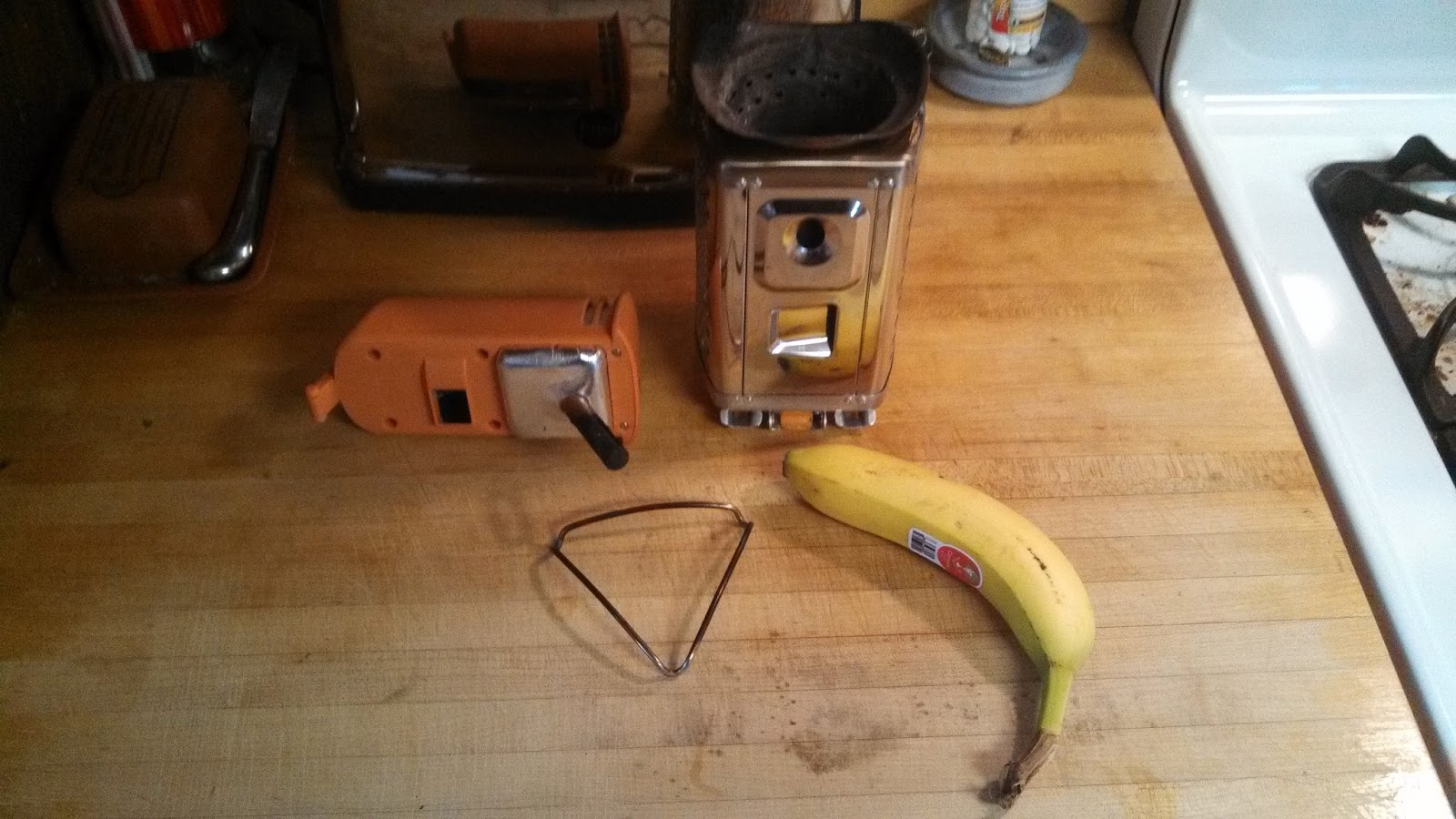
Disassembled:


Note the triangular piece by the banana. That's the pot support. You CAN cook without it. But, you shouldn't. Not if you can avoid it.


Just used in the field, at Michigan's Van Buren State Park:


Field Testing at Wisconsin's High Cliff State Park:


I had way too much fuel for it, and I had to break most of that in two:


Burning:


If I haven't scared you off yet, you can buy one from an outfitter such as REI, or on Amazon.